1. Folasaga
This manual provides comprehensive instructions for the setup, operation, and maintenance of your Xprinter XP-Q801K Thermal Receipt Printer. This printer is designed for efficient and reliable receipt printing in various business environments, featuring high-speed direct thermal printing and a USB interface for easy connectivity.

Ata 1: Luma view of the Xprinter XP-Q801K Thermal Receipt Printer, showing the paper output slot and control buttons.
2. Seti
2.1 Tatalaina
Aveese ma le fa'aeteete le lomitusi ma mea fa'aopoopo uma mai le afifi. Fa'amaonia o lo'o iai vaega uma:
- Xprinter XP-Q801K Thermal Receipt Printer
- Fetuunaiga Malosi
- Uaea USB
- Pepa Ta'ai (mea e amata ai)
- Tusi Lesona a le Tagata (lenei pepa)
2.2 Feso'ota'i le Lomitusi
Before connecting, ensure the printer is powered off. Locate the ports on the rear of the printer.
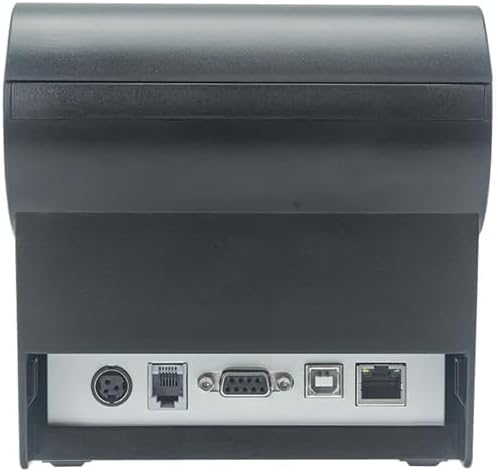
Ata 2: Tua view of the printer, highlighting the power, USB, and other interface ports.
- Fesoʻotaʻi le Mana: Insert the power adapter cable into the printer's power input port (DC 24V/2.5A) and plug the adapter into a suitable electrical outlet (AC 100-240V, 50-60Hz).
- Feso'ota'i le USB: Connect one end of the provided USB cable to the USB port on the printer and the other end to an available USB port on your computer.
- Cash Drawer (Optional): If using a cash drawer, connect its cable to the cash drawer port (DC 24V/1A) on the printer.
2.3 Loading the Paper Roll
The printer uses 80mm wide thermal paper rolls.
- Open the paper cover by pushing the cover open button (usually located on the side or front).
- Insert the thermal paper roll with the printing surface facing the print head. Ensure the roll is seated correctly in the paper compartment.
- Toso ese sina pepa i tua atu o le mea e tipi ai.
- Close the paper cover firmly until it clicks into place.
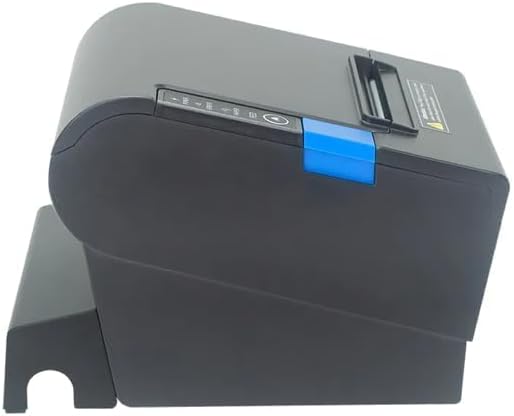
Ata 3: Itu view of the printer, illustrating the paper cover mechanism.
2.4 Fa'apipi'i Aveta'avale
The printer requires a driver to communicate with your computer. Drivers are typically available for Windows, Linux, Android, and Mac operating systems.
- For Windows users, the printer often supports plug-and-play installation or requires a specific Windows driver.
- For Linux, Android, and Mac, SDKs (Software Development Kits) are usually provided for integration.
Va'ai ile fale gaosi oloa website or the included driver CD/USB drive for the latest drivers and installation instructions specific to your operating system.
3. Fa'agaoioia o le Lomitusi
3.1 Fa'aola i luga/Pepe
Locate the power switch on the side or rear of the printer. Flip the switch to the 'ON' position to power on the printer. The 'POWER' indicator light will illuminate. Flip to 'OFF' to power down.
3.2 Indicator Lights and Buttons
The front panel typically features several indicator lights and buttons:
- MANA: Indicates the printer is powered on.
- SESE: Illuminates or flashes to indicate an error condition (e.g., paper out, print head overheating, cutter error).
- Pepa: Indicates that the paper roll is low or out.
- FEED button: Press to manually feed paper. Hold to perform a self-test print (if supported by model).
3.3 Lomitusi Fa'avae
Once the printer is connected and drivers are installed, you can print receipts from your POS software or application. Ensure the printer is selected as the default or active printer in your system settings.
The printer supports various print speeds up to 300 mm/s and automatic paper cutting after each print job.
4. Tausiga
Regular maintenance ensures optimal performance and extends the life of your printer.
4.1 Fa'amamaina o le Ulu Lomitusi
The print head should be cleaned regularly, especially if print quality degrades.
- Turn off the printer and disconnect the power cable.
- Tatala le faavaa pepa.
- Faaaoga māmā se vavae vavaeampened with isopropyl alcohol (ethanol) to gently wipe the thermal elements of the print head.
- Allow the print head to dry completely before closing the cover and reconnecting power.
4.2 Cleaning the Cutter
Paper dust can accumulate around the cutter blade, affecting its performance.
- Turn off the printer and disconnect the power cable.
- Carefully remove any visible paper dust or debris from around the cutter blade using a soft brush or compressed air.
- Do not use liquids on the cutter.
4.3 Fa'amama Lautele
Solo le pito i fafo o le lomitusi i se solo vaivai.amp ie. Aloese mai le fa'aaogaina o vaila'au malolosi po'o ni mea e fa'amama ai.
5. Faʻafitauli
O lenei vaega o loʻo faʻatalanoaina ai faʻafitauli masani e te ono feagai i lau masini lomitusi.
| Fa'afitauli | Mafuaaga e ono tupu | Fofo |
|---|---|---|
| E le ki le masini lomitusi. | Uaea eletise e le o feso'ota'i; Fa'aletonu le paoa; Pepe le paoa. | Ensure power cable is securely connected. Test power outlet. Turn power switch to 'ON'. |
| No printing. | Paper out; Paper loaded incorrectly; Driver not installed or incorrect; USB cable loose; Printer not selected. | Load new paper roll. Re-load paper correctly. Install/reinstall correct driver. Check USB connection. Select printer in software. |
| ERROR light is on/flashing. | Paper out; Paper jam; Print head overheating; Cutter error. | Load paper. Clear paper jam. Allow printer to cool down. Check cutter for obstructions. |
| Le lelei lomitusi. | Dirty print head; Low quality paper; Old paper roll. | Clean the print head (see Section 4.1). Use high-quality thermal paper. Replace old paper rolls. |
Afai e fa'aauau pea le fa'afitauli pe a uma ona taumafai i nei fofo, fa'amolemole fa'afeso'ota'i le lagolago a tagata fa'atau.
6. Fa'amatalaga
| Fa'aaliga | Fa'amatalaga |
|---|---|
| Metotia Lomitusi | Fa'asa'o Sa'o |
| Lautele Pepa | 80 mm |
| Lomiga Saosaoa | 230 mm/s, 260 mm/s, 300 mm/s |
| Fa'afeso'ota'i | USB |
| Laina Avanoa | 3.75 mm (adjustable by commands) |
| Character Size (ANK) | Font A: 1.5 × 3.0 mm (12 × 24 dots) Font B: 1.1 × 2.1 mm (9 × 17 dots) |
| Character Size (Chinese/Traditional Chinese) | 3.0 × 3.0 mm (24 × 24 dots) |
| Ituaiga Barcode | UPC-A / UPC-E / JAN13 (EAN13) / JAN8 (EAN8) / CODE39 / ITF / CODABAR / CODE93 / CODE128 |
| 2D Barcode | QR Code / PDF417 |
| NV Flash Memory | 256 KB |
| Malosiaga Ulufale | AC 100-240V, 50-60Hz |
| Malosiaga o Galuega | DC 24V/2.5A |
| Tupe Totogi Fa'asoa | DC 24V/1A |
| mamafa | 1.0 kilokalama |
| Fua (D × W × H) | 194.5 × 145 × 146.4 mm |
| Galulue Vevela | 0~45°C |
| Susū fa'agaioiga | 10~80% RH |
| Olaga tipi | 1.5 miliona tipi |
| Lolomi Ulu Ola | 150 kilomita |
| OS Fegalegaleaiga | Windows, Linux, Android, Mac |


