1. Folasaga
Fa'afetai mo le fa'atauasing the DOOMAY Digital Alarm Clock. This compact and versatile alarm clock is designed for convenience and readability, featuring an adjustable LCD display, snooze function, weekend mode, and temperature display. This manual will guide you through the setup, operation, and maintenance of your new alarm clock to ensure optimal performance.
2. Fa'amatalaga Saogalemu
- Taofi le masini mamao mai le vai ma siosiomaga e maualuga le susū.
- Avoid exposing the clock to direct sunlight or extreme temperatures.
- Aua le taumafai e tatala pe toe faaleleia le masini oe lava. Faasino i tagata agavaa mo le tausiga.
- Use only the specified battery type (2 x AAA batteries).
- Aveese maa pe afai o le a le fa'aogaina le masini mo se vaitaimi umi e puipuia ai le lepa.
- Taofi ma'a ia aua ne'i maua e tamaiti.
3. Mea i totonu o le afifi
- DOOMAY Digital Alarm Clock (1 unit)
- AAA Batteries (2 units)
- Tusi Lesona a le Tagata (lenei pepa)
4. Oloa Ua Ovaview
Familiarize yourself with the components and controls of your DOOMAY Digital Alarm Clock.
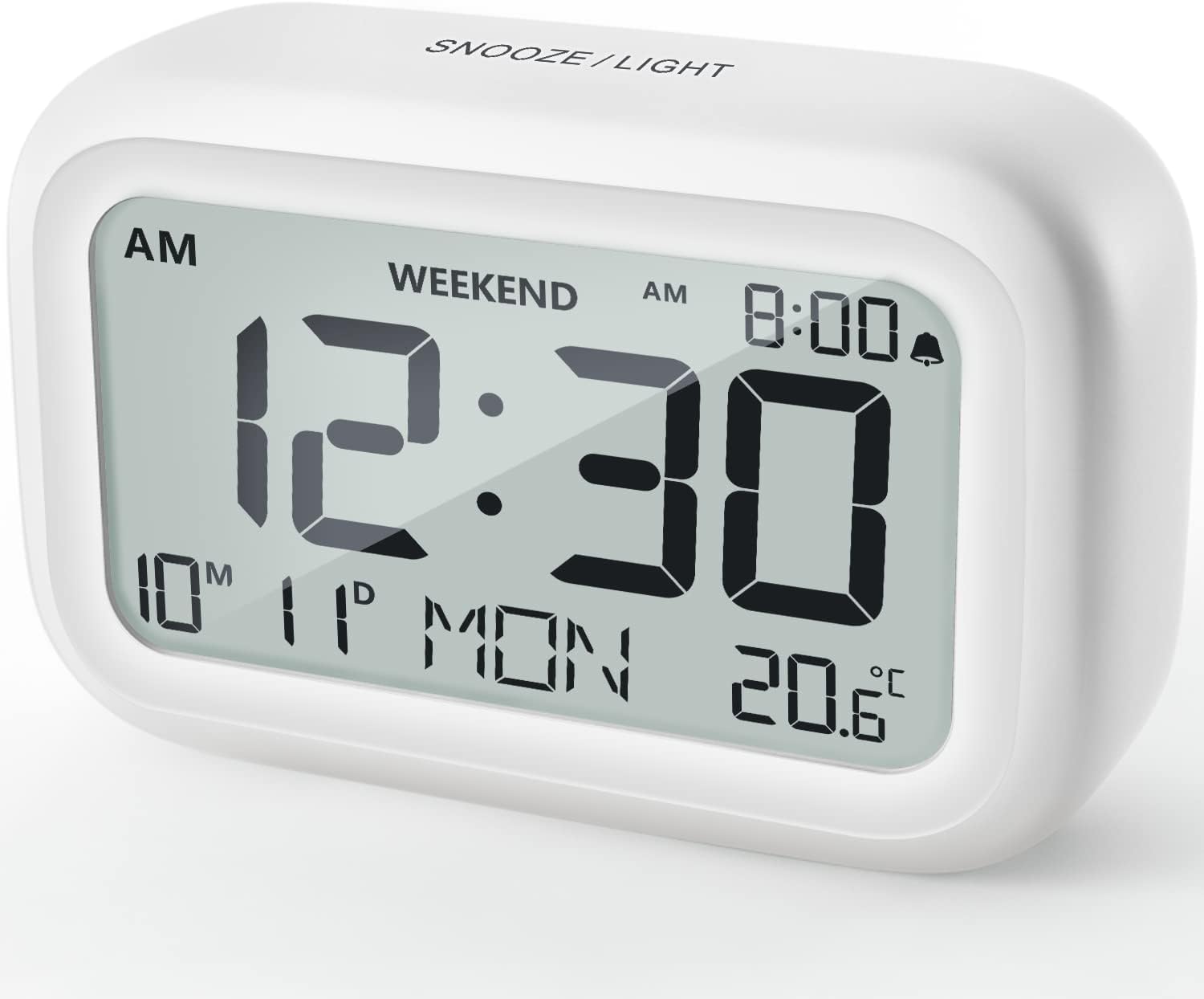
Ata 4.1: Luma View of the Alarm Clock
This image displays the front of the DOOMAY Digital Alarm Clock, highlighting its large, clear LCD screen. The screen shows the current time (12:30), AM indicator, day of the week (MON), date (10th month, 11th day), and indoor temperature (20.6°C). The top of the clock has a "SNOOZE/LIGHT" button.

Ata 4.2: Vaega Autu I lugaview
This diagram illustrates the main functionalities of the alarm clock: 12/24H time display, calendar, alarm setting, adjustable volume, snooze function, backlight, weekend mode, and temperature display. The clock itself is shown on a wooden table, displaying 7:00 AM, Friday, and 28.8 degrees.

Figure 4.3: Back Panel Controls
This image shows the rear of the alarm clock, detailing the various control buttons and the battery compartment. Buttons are clearly labeled for: 12/24H time format, Alarm setting, Weekend mode, Date setting, Minus (-) for decreasing values, Plus (+) for increasing values, and °C/°F for temperature unit selection. The battery compartment is visible, designed for two AAA batteries.
Pulea ma Fa'aaliga:
- Fa'aaliga LCD: Shows time, date, day of week, AM/PM indicator, alarm status, and temperature.
- SNOOZE/LIGHT Button (Top): Activates snooze function during alarm; illuminates backlight for 5 seconds.
- 12/24H Button (Back): Toggles between 12-hour and 24-hour time formats.
- ALARM Button (Back): Enters alarm setting mode.
- WEEKEND Button (Back): Activates/deactivates weekend mode.
- DATE Button (Back): Enters date setting mode.
- MINUS (-) Button (Back): Decreases values during setting; adjusts alarm volume.
- PLUS (+) Button (Back): Increases values during setting; adjusts alarm volume.
- °C/°F Button (Back): E sui i le va o Celsius ma Fahrenheit iunite vevela.
5. Seti
5.1 Fa'apipi'i ma'a
- Tatala le ufiufi vaega o maa o lo'o i tua o le uati.
- Insert two (2) AAA batteries, ensuring correct polarity (+ and -).
- Tapuni lelei le ufiufi o le vaega o maa.
- The display will light up, and the clock will be ready for initial setup. A low battery symbol will appear when batteries need replacement. If the display shows "8888" flashing, it's also an indication to change batteries.
5.2 Taimi Muamua ma le Aso e Faatulaga ai
- Seti Taimi:
- Oomi le 12/24H button to switch between 12-hour (with AM/PM) and 24-hour formats.
- Oomi ma uu le 12/24H fa'amau mo le 3 sekone e ulufale ai i le fa'atulagaina o taimi. O numera o le itula o le a emo.
- Fa'aaoga le + or - faamau e fetuunai ai le itula.
- Oomi le 12/24H button again to confirm the hour and move to minute setting. The minute digits will flash.
- Fa'aaoga le + or - faamau e fetuunai ai le minute.
- Oomi le 12/24H button one more time to exit time setting.
- Seti Aso:
- Oomi ma uu le ASO button for 3 seconds to enter date setting mode. The year digits will flash.
- Fa'aaoga le + or - faamau e fetuunai ai le tausaga.
- Oomi le ASO button again to confirm the year and move to month setting.
- Adjust the month using + or -.
- Tusitala ASO again to move to day setting.
- Adjust the day using + or -.
- Tusitala ASO one more time to exit date setting. The day of the week will automatically adjust.
6. Fa'atonuga o Galuega
6.1 Faʻatuina o le Ala Ala
- Oomi ma uu le ALAGALO faamau mo le 3 sekone. O numera o itula fa'ailo o le a emo.
- Fa'aaoga le + or - faamau e seti ai le itula fa'ailo mana'omia.
- Oomi le ALAGALO button again to confirm the hour and move to minute setting. The alarm minute digits will flash.
- Fa'aaoga le + or - buttons to set the desired alarm minute.
- Oomi le ALAGALO button one more time to exit alarm setting. The alarm icon (bell symbol) will appear on the display, indicating the alarm is active.
- To turn the alarm ON/OFF, simply press the ALAGALO button once. The bell icon will appear/disappear.
6.2 Faʻatino Galuega
When the alarm sounds, gently tap the large SNOOZE / Malamalama button on the top of the clock. The alarm will pause for 9 minutes and then sound again. This can be repeated multiple times.

Figure 6.1: Activating Snooze
This image demonstrates how to activate the snooze function by touching the top of the alarm clock. The text highlights that this action provides an additional 9 minutes of sleep after the alarm sounds.
To completely turn off the alarm after it sounds (without snoozing), press any button on the back of the clock.
6.3 Weekend Mode
The weekend mode allows the alarm to sound only from Monday to Friday, preventing it from ringing on Saturday and Sunday.

Figure 6.2: Weekend Mode Activated
This image shows the alarm clock display with the "WEEKEND" indicator prominently displayed, signifying that the weekend mode is active. The accompanying text clarifies that in this mode, the alarm will only sound from Monday to Friday, ensuring undisturbed weekends.
- To activate Weekend Mode, press the VAIASO button once. The "WEEKEND" indicator will appear on the display.
- To deactivate Weekend Mode, press the VAIASO button again. The "WEEKEND" indicator will disappear.
6.4 Adjustable Alarm Volume
The alarm clock offers two volume levels: Low (70 dB) and High (85 dB).

Figure 6.3: Alarm Volume Levels
This image visually represents the two available alarm volume settings: L01 (85 dB) for a louder alarm and L02 (70 dB) for a softer alarm. The alarm clock is shown in a bedroom setting, emphasizing its use as a bedside device.
- While in normal time display mode, press the + or - buttons to cycle between the two alarm volume levels. The current volume level will be briefly displayed.
6.5 Galuega Fa'afo'i o le Moli i Tua
To illuminate the display in low light conditions, simply tap the SNOOZE / Malamalama button on the top of the clock. The backlight will activate for approximately 5 seconds, providing clear visibility of the time and other information.
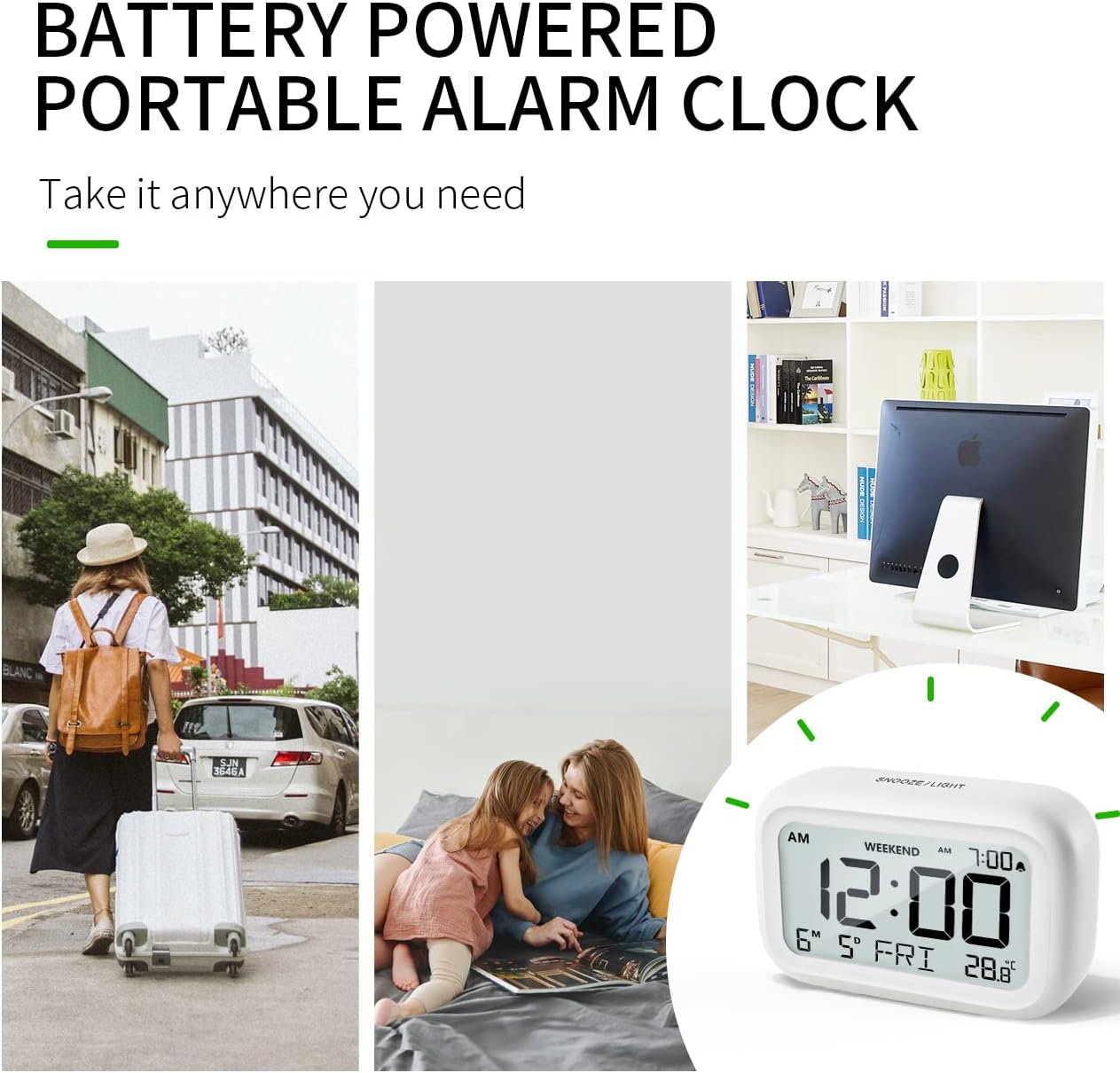
Figure 6.4: Backlight in Action
This image provides a side-by-side comparison of the alarm clock's display. On the left, the clock is shown in a well-lit environment. On the right, the same clock is shown in a dark setting with its 5-second backlight activated, demonstrating how the display becomes clearly visible at night.
6.6 Fa'aalia le vevela
The clock displays the indoor temperature. You can switch between Celsius (°C) and Fahrenheit (°F) units.
- To change the temperature unit, press the ° C / ° F faamau i tua o le uati.
7. Tausiga
7.1 Fa'amamāina
Wipe the clock with a soft, dry cloth. Do not use abrasive cleaners or solvents, as they may damage the surface.
7.2 Suiga maa
When the low battery indicator appears on the display, or if the display shows "8888" flashing, it is time to replace the batteries. Follow the steps in Section 5.1 Battery Installation to replace the two AAA batteries.
8. Faʻafitauli
| Fa'afitauli | Mafuaaga e ono tupu | Fofo |
|---|---|---|
| E avanoa pe faanenefu. | Ua mate maa pe ua sese foi le faapipiiina. | Sui maa i maa AAA fou, ia mautinoa le sa'o o le polarity. |
| E le leo le faailo. | Alarm is not activated, or Weekend Mode is ON. | Ensure the alarm icon is displayed. Check if Weekend Mode is active and deactivate if necessary. |
| Snooze function not working. | Not tapping the SNOOZE/LIGHT button correctly. | Ensure a firm, brief tap on the top SNOOZE/LIGHT button when the alarm is sounding. |
| E sese le Taimi/Aso. | Not set correctly or batteries were removed. | Refer to Section 5.2 Initial Time and Date Setting to re-set. |
9. Fa'amatalaga
| Fa'aaliga | Fa'amatalaga |
|---|---|
| Numera Fa'ata'ita'i | 5293UK |
| Fa'ailoga | FA'AIGA |
| Fua (L x W x H) | 10.9 x 3.81 x 6.9 cm (4.29 x 1.5 x 2.72 inisi) |
| mamafa | 127.01 kalama (0.28 lbs) |
| Mea | Acrylonitrile Butadiene Styrene (ABS) |
| Punavai Malosi | 2 x AAA maa (aofia ai) |
| Fa'aaliga Ituaiga | LCD faafuainumera |
| Tulaga o le Leo Fa'ailo | Low (70 dB), High (85 dB) |
| Tale umi | 9 minute |
| Umi o le moli tua | 5 sekone |
| Vaega o le vevela | Celsius (°C) / Fahrenheit (°F) |
10. Fa'amaonia ma Lagolago
DOOMAY products are designed for reliability and performance. For any questions, technical support, or warranty claims, please contact your retailer or visit the official DOOMAY web'upega tafaʻilagi mo se fesoasoani. Faʻamolemole taofi lau faʻamaoniga o le faʻatau mo le faʻamoemoega o le tusi saisai.
For further information, you may visit the brand's Amazon store page: DOOMAY Store on Amazon


