
Folasaga
This manual provides essential instructions for the safe and effective operation, maintenance, and troubleshooting of your Strongway Manual Chain Hoist. This commercial-grade hoist features heat-treated double pawls for reliable brakes and meets ASME B30.16/ASME HST-2:2014 safety standards. It is constructed with a durable high-strength steel frame and gear case, a Grade 80 load chain, and uses lithium grease for optimal performance. The hoist includes tough ductile drop-forged hooks designed to show noticeable opening under excessive overload, enhancing safety. The blackening side plate, zinc-plated hand chain with a rolled-edge design, and asbestos-free friction disc contribute to smooth operation. A cast steel safety latch on the 360° swivel hook further increases safety during use.
Fa'amatalaga Saogalemu
LAPATA'IGA: O le le mulimulita'i i nei faatonuga mo le saogalemu e ono i'u ai i se manu'a tuga po'o le oti.
- Always inspect the hoist before each use for any signs of damage, wear, or malfunction. Do not use if damaged.
- Ensure the hoist is securely attached to a suitable support structure capable of safely handling the maximum rated load.
- Never exceed the rated capacity of 4400 lbs (2 tons). Overloading can cause hoist failure.
- Ensure the load is properly balanced and secured before lifting. Use appropriate slings or attachments.
- Keep hands and body clear of the load and moving parts during operation.
- Do not use the hoist to lift people or loads over people.
- Operate the hoist smoothly; avoid sudden jerking or swinging of the load.
- Aua le tu'ua se uta fa'atali e aunoa ma se tausiga.
- Ensure the load chain is free of twists, kinks, or damage.
- Wear appropriate personal protective equipment (PPE), including safety gloves and eye protection.
- This hoist meets ASME B30.16/ASME HST-2:2014 safety standards. Adherence to these standards is crucial.
Oloa Fa'ailoga
- Commercial-grade design: Engineered for performance and durability in demanding environments.
- Heat-treated double pawls: Ensures good spring action and reliable braking mechanisms.
- Tulaga Saogalemu: Meets ASME B30.16/ASME HST-2:2014 safety standards for industrial hoists.
- Fausiaga Tumau: Features a high-strength steel frame and gear case, Grade 80 load chain, and lithium grease for high performance and longevity.
- Puipuiga ovata: Tough ductile drop-forged hooks are designed to show noticeable opening when subjected to excessive overload, providing a visual warning.
- Fa'agaioiga lelei: Blackening side plate, zinc-plated hand chain with rolled-edge design, and asbestos-free friction disc ensure smooth and consistent operation.
- Enhanced Safety Hook: Cast steel safety latch on the 360° swivel hook increases security during lifting operations.
Seti
- Tatalaina: Carefully remove the hoist from its packaging. Inspect for any shipping damage. Report any damage to the supplier immediately.
- Nofoaga fa'apipi'i: Select a mounting point that is structurally sound and capable of supporting the hoist's weight plus the maximum rated load with an adequate safety factor. This could be a beam, trolley, or other approved overhead support.
- Puipuiga Fa'apipi'i: Attach the hoist's upper hook securely to the chosen mounting point. Ensure the safety latch on the hook is fully closed and engaged.
- Su'ega filifili: Before first use, fully extend the load chain and hand chain. Check for any twists, kinks, damage, or foreign material. Ensure the chain moves freely through the hoist mechanism.
- Fa'atino Su'ega: Perform a test lift with a light load to ensure all mechanisms (lifting, lowering, braking) function correctly.
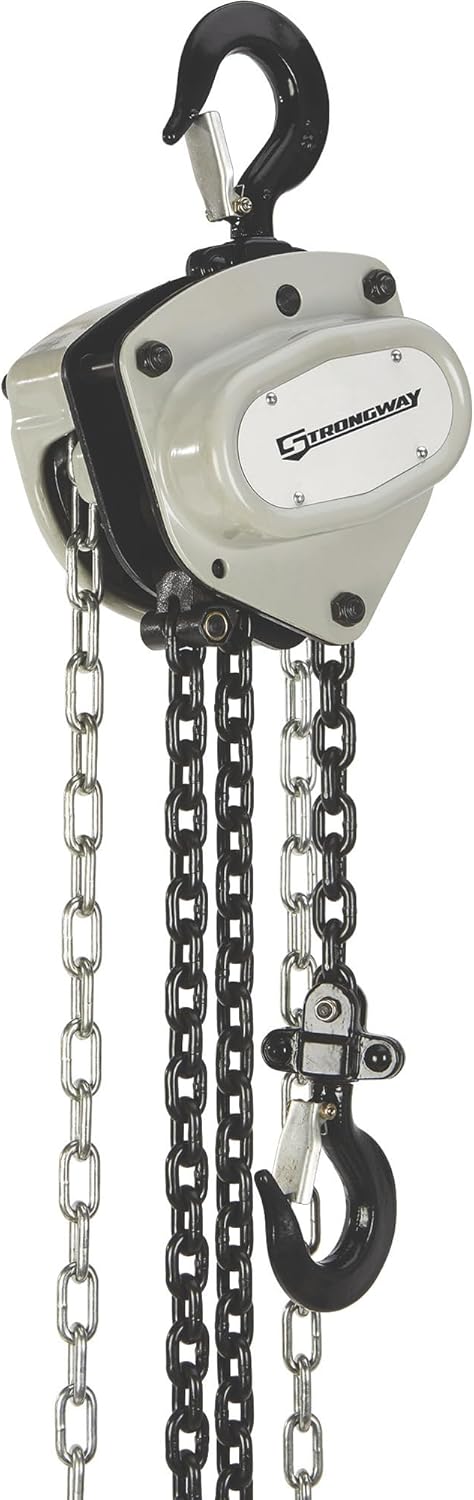
Image: The Strongway Manual Chain Hoist, showing the main body, load chain, and hand chain. This view helps in identifying the hoist components during setup.
Fa'atonuga o Galuega
- Feso'ota'i le uta: Attach the lower hook securely to the load using appropriate lifting accessories (slings, shackles, etc.). Ensure the safety latch on the lower hook is fully closed and engaged. The 360° swivel hook allows for flexible positioning.
- Lifting the Load: Pull the hand chain downwards to lift the load. Pulling one side of the hand chain will engage the lifting mechanism. Maintain a steady, controlled pull.
- Fa'aitiitia o le Avega: To lower the load, pull the other side of the hand chain. The braking mechanism will control the descent. Ensure a slow, controlled lowering motion.
- taofi: The hoist features a reliable braking system that automatically engages when the hand chain is released, holding the load securely in position.
- Puleaina o uta: Always maintain control of the load. Avoid swinging or sudden movements.
- Ina ua uma ona fa'aoga: Once the load is safely placed, remove the lower hook. Store the hoist in a clean, dry place, free from corrosive elements.

Ata: O se auiliiliga view of the hoist's lower hook, highlighting the cast steel safety latch and its 360° swivel capability, crucial for secure load attachment.
Tausiga
- Asiasiga masani: Conduct daily or pre-shift inspections of the hoist, including the load chain, hand chain, hooks, safety latches, and housing for any signs of wear, damage, or deformation.
- Lubrication: Periodically lubricate the load chain and internal moving parts with lithium grease, as specified for high performance. Refer to the manufacturer's recommendations for lubrication points and frequency.
- Fa'amamaina: Keep the hoist clean and free from dirt, dust, and debris. A clean hoist operates more efficiently and allows for easier inspection.
- Chain Condition: Inspect the load chain for stretching, nicks, gouges, or corrosion. Replace the chain if any damage is found. Ensure the hand chain is also in good condition.
- Su'esu'ega o le Matau: Check hooks for any signs of bending, twisting, or cracks. The ductile drop-forged hooks are designed to show noticeable opening under excessive overload; if this is observed, the hook must be replaced. Ensure safety latches operate freely and fully engage.
- Au'aunaga fa'apolofesa: For internal component inspection or repair, it is recommended to have the hoist serviced by qualified personnel.
Fa'afitauli
| Fa'afitauli | Mafuaaga e ono tupu | Fofo |
|---|---|---|
| E lē faigata ona si'i pe tu'u i lalo le hoist. |
|
|
| Load slips or drifts after lifting. |
|
|
| Hand chain is difficult to pull. |
|
|
If problems persist or you are unsure about any repair, contact qualified service personnel or the manufacturer.
Fa'amatalaga
| Fa'aaliga | Fa'amatalaga |
|---|---|
| Numera Fa'ata'ita'i | 3393559 |
| Malosiaga | 4400 lbs (2 Tons) |
| Sii Maualuluga | 20 ft |
| Load Chain Grade | Vasega 80 |
| Tulaga Saogalemu | ASME B30.16/ASME HST-2:2014 |
| Mea mamafa | 53.8 pauna |
| Fuafuaga Mea | 15 x 10 x 10 inisi |
| Tufuga | Strongway |
Fa'amaonia ma Lagolago
For warranty information or technical support regarding your Strongway Manual Chain Hoist, please refer to the documentation included with your purchase or contact Strongway customer service directly. Details can often be found on the manufacturer's official webnofoaga po'o le fa'atau oloa na fa'atauina ai le oloa.
Tufuga: Strongway
Numera Fa'ata'ita'i: 3393559
Aso Muamua Maua: Iulai 27, 2018