
Tekmar 150 One Stage Setpoint Control
Tusi Taiala
1. Folasaga
This manual provides comprehensive instructions for the installation, operation, and maintenance of the Tekmar 150 One Stage Setpoint Control. This device is designed to manage heating or cooling systems based on a single setpoint, ensuring efficient and reliable performance.
Please read this manual thoroughly before installation and use to ensure proper function, safety, and to prevent damage to the unit or associated equipment. Keep this manual for future reference.
2. Fa'amatalaga Saogalemu
Adherence to the following safety guidelines is crucial for preventing personal injury and damage to the equipment:
- motusia le Malosi: Always disconnect the main power supply before installing, servicing, or removing the control unit. Failure to do so may result in electrical shock or equipment damage.
- Tagata faigaluega agavaa: Installation and wiring must be performed by qualified, licensed personnel in accordance with all local and national electrical codes.
- Fa'aoga tatau: Use this product only for its intended purpose as described in this manual. Any other use may void the warranty and create a hazard.
- Tulaga Siosiomaga: Do not expose the control to water, excessive humidity, or extreme temperatures outside its specified operating range.
- Asiasiga: Regularly inspect the unit for any signs of damage. Do not operate the control if it appears damaged.
3. Mea i totonu o le afifi
Fa'amautinoa o lo'o iai mea uma i totonu o le afifi:
- Tekmar 150 One Stage Setpoint Control Unit
- Fa'apipi'i Meafaigaluega (sulu, taula)
- Tusi Faʻatonuga (lenei pepa)
4. Seti ma Fa'apipi'i
4.1 Faʻaputuga Nofoaga
Select a suitable indoor location for mounting the Tekmar 150 control. The location should be:
- Easily accessible for operation and maintenance.
- Free from direct sunlight, drafts, or heat sources that could affect its temperature sensing.
- Away from areas with high vibration or electromagnetic interference.
4.2 Fa'amauina o le Iunite
- Mark the desired mounting points on the wall using the control unit as a template.
- Drill pilot holes if necessary and insert wall anchors.
- Secure the control unit to the wall using the provided mounting hardware. Ensure it is level and firmly attached.
4.3 Feso'ota'iga Uaea
WARNING: Ensure power is disconnected before proceeding with wiring.
Refer to the wiring diagram provided on the back of the control unit or in the separate wiring schematic (if applicable). Connect the power supply, sensor inputs, and controlled equipment outputs to the appropriate terminals. Ensure all connections are secure and comply with local electrical codes.
Use appropriate gauge wiring for all connections. Incorrect wiring can damage the unit or connected equipment.
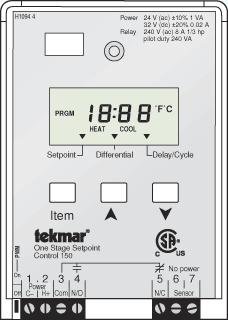
Image showing the front view of the Tekmar 150 One Stage Setpoint Control unit, typically used for managing heating or cooling systems based on a single setpoint. The display and control buttons are visible.
5. Galuega
5.1 Uluai Malosiaga
After all wiring is complete and verified, restore power to the control unit. The unit will perform a brief self-test, and the display (if present) will illuminate. The default setpoint or current operating status will be shown.
5.2 Setting the Setpoint
The Tekmar 150 allows for easy adjustment of the desired setpoint. Use the designated adjustment dial or buttons (refer to the unit's front panel) to increase or decrease the setpoint value. The display will show the current setpoint as you adjust it.
- Fa'amau i luga/I lalo: Press the 'Up' or 'Down' buttons to change the setpoint.
- vili: Rotate the dial clockwise to increase the setpoint, counter-clockwise to decrease.
The control will automatically adjust its output to maintain the system at the setpoint.
5.3 Fa'ailoga Molī
The control unit may feature indicator lights to show its operational status:
- Power (Green): Fa'ailoa mai ai o lo'o maua e le iunite le eletise.
- Output Active (Amber/Red): Indicates that the control is actively calling for heating or cooling.
- Error (Red/Flashing): Indicates a fault condition. Refer to the troubleshooting section.
6. Tausiga
The Tekmar 150 One Stage Setpoint Control is designed for reliable, long-term operation with minimal maintenance. However, periodic checks can help ensure optimal performance:
- Fa'amamaina: Periodically wipe the exterior of the unit with a soft, dry cloth to remove dust and debris. Do not use abrasive cleaners or solvents.
- So'oga: Annually, inspect all wiring connections to ensure they are secure and free from corrosion.
- Leai ni vaega e mafai ona fa'aaogaina e tagata fa'aoga: There are no user-serviceable parts inside the control unit. Do not attempt to open or repair the unit yourself. Refer all servicing to qualified personnel.
7. Faʻafitauli
If you experience issues with your Tekmar 150 control, consult the following table before contacting technical support:
| Fa'afitauli | Mafuaaga e ono tupu | Fofo |
|---|---|---|
| E le o ola le iunite | No power supply; Loose wiring connection | Check circuit breaker; Verify power connections (ensure power is off before checking wiring). |
| System not responding to setpoint changes | Incorrect wiring; Sensor fault; System lockout | Verify wiring against diagram; Check sensor connections; Consult system manual for lockout procedures. |
| Fa'aaliga fa'aalia fa'ailoga sese | Internal fault; Sensor issue | Note the error code and contact technical support. Try cycling power to reset. |
| Le sa'o le faitau o le vevela | Sensor placement; Damaged sensor; Loose sensor connection | Relocate sensor away from drafts/heat sources; Inspect sensor and wiring; Re-secure connections. |
If the problem persists after attempting these solutions, contact Tekmar technical support.
8. Fa'amatalaga
| Fa'aaliga | Fa'amatalaga |
|---|---|
| Fa'ailoga | tekmar |
| Fa'ata'ita'iga | 150 |
| Metotia Pulea | Mamao |
| Mea mamafa | 4 pauna |
| UPC | 642415186605 |
| ASIN | B0057GRJO2 |
| Fa'aoga i totonu/I fafo | I totonu |
9. Fa'amaonia ma Lagolago
Tekmar products are manufactured to high standards and are backed by a limited warranty. For specific warranty terms and conditions, please refer to the warranty card included with your product or visit the official Tekmar webnofoaga.
For technical assistance, troubleshooting beyond this manual, or to inquire about replacement parts, please contact Tekmar customer service. Have your product model number and purchase date available when contacting support.
Tekmar Customer Support:
- Contact information not provided in product data. Please refer to Tekmar's official website or product packaging for current support details.